PART 1: THE LITTLE ELEPHANT WHO WAS LOST IN A GIANT FOREST
For hours, the tiny elephant calf had been alone in a world that suddenly felt enormous. Deep inside the green forests of Tamil Nadu, India, a young Asian elephant found himself separated from the only family he had ever known. At just a few months old, he was still at the most vulnerable stage of his life. His mother was not just a parent; she was his entire world. She was the source of his protection, his food, his guidance, and the familiar presence that told him he was safe. Without her beside him, the forest that normally represented home became a place filled with uncertainty. Every unfamiliar sound, every movement in the trees, and every passing moment created another challenge for a calf too young to survive on his own.
Elephant calves depend heavily on their families during their earliest years. They learn where to walk, where to find water, how to respond to danger, and how to communicate by watching the older elephants around them. A young elephant separated from its herd is not simply lost geographically. It is lost emotionally and physically. The sounds of the herd, especially the calls of its mother, are what guide it through the world. For this little calf, every hour away from his family was an hour of confusion and fear.
But somewhere in the vast forest, his family was still searching too. The bond between elephants is one of the strongest in the animal kingdom. Herds are built around cooperation, memory, and deep social connections. A mother elephant can recognize her calf among many others, and a calf can identify its family through sounds and scents that humans could never fully understand. The rescue team knew they were not simply trying to save one animal. They were trying to restore a relationship that was essential to his survival.
PART 2: THE SEARCH THROUGH THE WILDERNESS
When forest staff learned that the young elephant had been separated from his herd, they immediately began searching the surrounding area. But finding the calf was only the first challenge. The real mission was much more delicate: finding his family and bringing them back together safely.
Wildlife rescues involving elephants require patience and careful planning. A frightened calf can become stressed easily, and adult elephants can react unpredictably if they sense danger near their young. The rescuers could not simply pick up the baby and move him somewhere else. The goal was not to make the elephant dependent on humans. The goal was to return him to the wild life he belonged to.
The search continued through dense forest terrain where thick vegetation made movement difficult. From the ground, visibility was limited. Trees, bushes, and uneven landscapes made it almost impossible to see large areas at once. The team needed another way to understand what was happening beyond the paths they could walk.
That was when technology became an important part of the rescue.
Drones were used to scan areas that were difficult to reach on foot. From above, rescuers searched for signs of elephant movement, looking for the patterns that could reveal where the herd was traveling. They carefully studied the forest, searching for any indication that the calf’s family was nearby.
The hours passed slowly.
The little elephant waited.
The rescue team searched.
And somewhere in that endless forest, his herd continued moving through the trees.
PART 3: THE MOMENT THE HERD WAS FINALLY FOUND
Eventually, after hours of searching, the team received the news they had been hoping for.
The herd had been located.
For the rescuers, it was a moment of relief. But they also understood that the hardest part was not over yet. Finding the family was only the beginning. The reunion had to happen in a way that allowed the elephants to recognize each other naturally and safely.
Wild animals do not understand human intentions. The people who had worked tirelessly to help the calf were strangers in the elephant’s world. They could provide support, but they could not replace the family bond that had been broken.
So the team moved carefully.
They gave the elephants space.
They avoided unnecessary disturbance.
They allowed the natural connection between the calf and his herd to guide the final steps.
Everyone watching understood that this was not a moment that could be forced. A mother elephant does not need instructions to recognize her baby. A calf does not need to be taught who his family is. That connection exists beyond human explanation.
The young elephant had spent hours surrounded by unfamiliar sights and sounds.
Now he was finally moving toward the place where he belonged.
See more on the next page
PART 4: THE REUNION THAT BROUGHT HIM PEACE
Then came the moment everyone had been waiting for.
The little elephant was reunited with his family.
After the fear, the confusion, and the uncertainty, he was surrounded once again by the presence of his herd. The familiar sounds returned. The familiar scents returned. The feeling of safety returned.
But the most emotional part of the reunion came afterward.
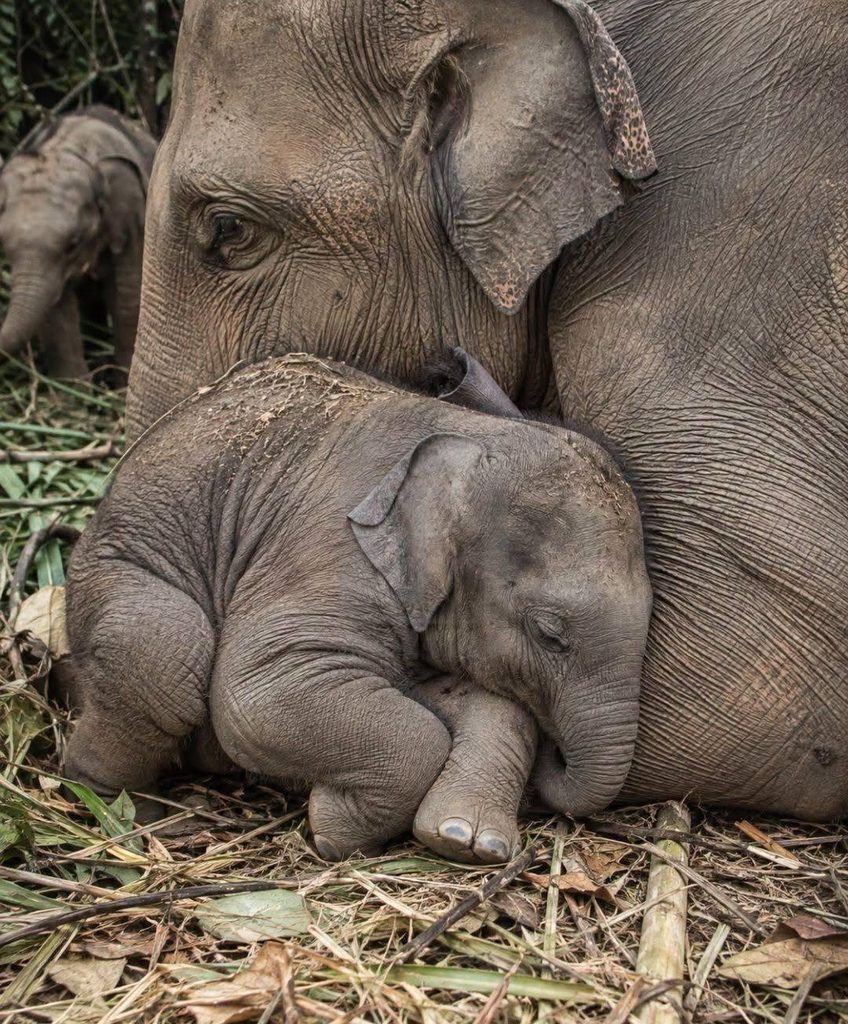
Once everything settled, the exhausted calf moved close to an adult elephant believed to be his mother. His tiny body rested against her enormous frame. His small trunk curled near his face. The same baby who had spent hours wandering alone finally allowed himself to relax.
Then he slept.
That simple moment touched everyone who witnessed it.
Because sleep is something an animal only does when it feels safe.
The calf no longer needed to search.
He no longer needed to worry.
He no longer needed to wonder where his family had gone.
The enormous elephant beside him represented everything he had been missing.
Warmth.
Protection.
Comfort.
Home.
For a human watching the scene, it was easy to understand why it was so powerful. The calf did not know about rescue operations. He did not understand the drones, the searching, or the careful planning that had brought him back.
He only knew one thing.
His family was there.
PART 5: THE FAMILY THAT MEANT EVERYTHING
Elephants are among the most emotionally complex animals on Earth. Their lives revolve around relationships. They remember individuals for years. They protect their young. They cooperate with members of their herd. They experience moments of joy, fear, and what appears to be grief.
For this little calf, being reunited with his herd meant more than simply returning to a familiar location.
It meant returning to the world where he belonged.
A baby elephant cannot survive because humans care for it for a few hours. It survives because its family teaches it how to live. The older elephants provide knowledge that cannot be replaced. They know the forest paths. They know where to find food and water. They know how to protect the youngest members of the group.
That is why the rescue team’s greatest achievement was not keeping the calf safe.
It was making sure he did not need them anymore.
The best wildlife rescues are often the ones where humans eventually disappear from the story.
The animal returns to its natural life.
The family continues.
The wild remains wild.
PART 6: THE BEAUTIFUL ENDING THAT NEEDED NO WORDS
For the forest workers who spent hours searching for this little elephant, seeing him finally resting beside his family was the reward they hoped for.
They did not need the calf to recognize them.
They did not need him to stay near them.
They did not need him to understand what they had done.
Their success was knowing that he could leave them behind.
Because the greatest sign of a successful rescue is not an animal looking toward humans.
It is an animal no longer needing humans.
This little elephant had been lost in a forest that suddenly felt too large for him.
But after patience, dedication, and compassion, he found his way back to the place where he was always meant to be.
Beside his family.
Under the protection of his herd.
Safe once again.
Sometimes love does not need words.
Sometimes it is simply a mother standing nearby.
Sometimes it is a tiny elephant finally closing his eyes.
Sometimes the happiest ending is not a goodbye between an animal and its rescuers.
Sometimes the happiest ending is watching that animal walk away into the wild, exactly where it belongs.
